Key Takeaways
- Researchers say they built a probabilistic computer with 1 million p-bits spread across 18 FPGAs.
- The machine is designed to handle stochastic problems by coordinating noisy, correlated bit flips.
- The team says its results suggest a path to larger probabilistic computers without global lockstep synchronization.
What happened
Scientists led by Kerem Çamsarı say they have built the largest probabilistic computer reported so far, a system with 1 million probabilistic bits, or p-bits. The work was posted on arXiv on 24 June.
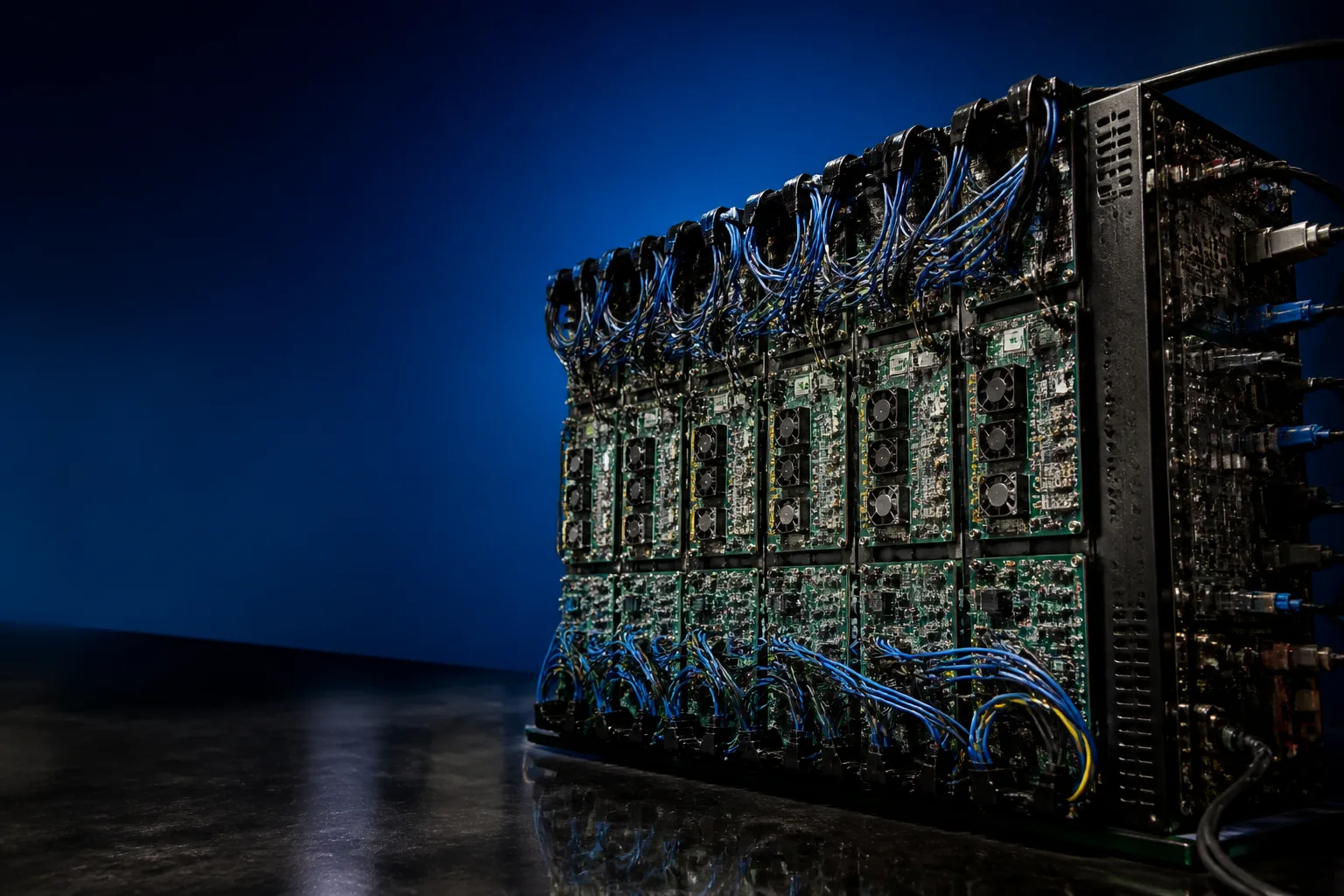
The machine uses 18 field-programmable gate arrays, or FPGAs, rather than physical flipping bits. In this setup, the chips are reconfigured in software to implement probabilistic behavior. Together, the system is described as capable of more than a trillion flips per second.
P-bits occupy a middle ground between standard bits and qubits. Standard bits are binary, while p-bits flip between 0 and 1 with tunable probability. When many p-bits are coupled and correlated, they can be used for stochastic problems, including optimization tasks such as finding an efficient route for deliveries.
The researchers say this machine differs from other stochastic hardware such as QUBO devices and Ising machines because probabilistic computers are intended to be programmable general-purpose machines rather than hardware hardwired for a single problem.
Why it matters
The central question in the study is scalability. Earlier probabilistic computers were much smaller: a 2019 Nature study built one with eight p-bits, and a 2023 system reached 7,200 p-bits. Those machines were confined to a single chip, which made it unclear whether probabilistic computers could be networked into much larger systems.
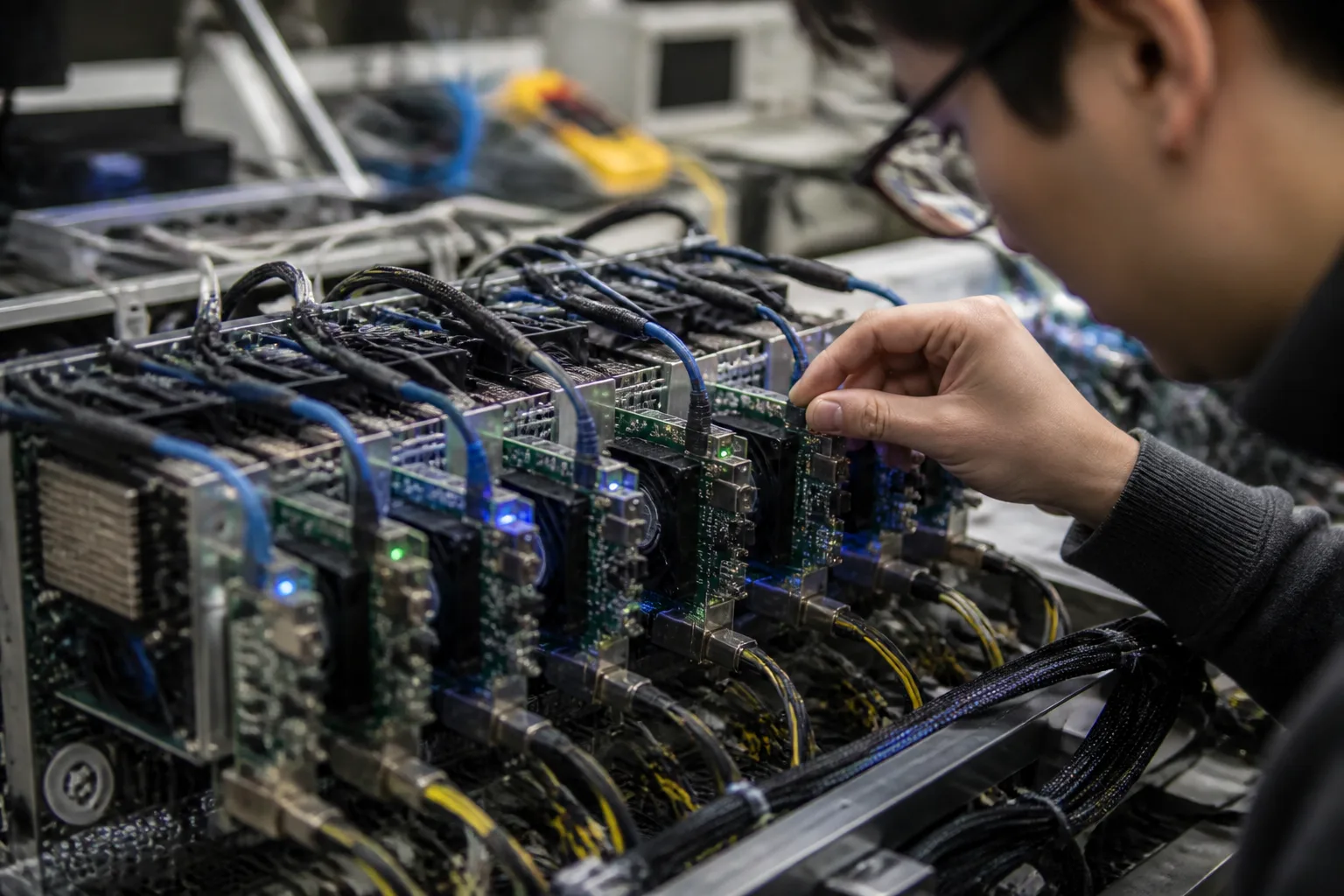
That challenge is not trivial. The behavior of probabilistic computing depends on correlated fluctuations, so synchronizing data across multiple chips is harder than connecting conventional CPUs or GPUs. The new system suggests that large-scale coordination may be possible without global lockstep synchronization.
Navid Anjum Aadit, a postdoctoral scholar in electrical engineering at Stanford University, said the machine communicates without global lockstep synchronization. The researchers also report a simple design rule for how quickly chips must exchange data in order to behave as one computer. Below that threshold, they say there is a tradeoff between speed and accuracy.
If that rule holds up, it could help define a path to arbitrarily large probabilistic computers built from many chips, similar to how standard computers are scaled today. The authors also say the findings should apply to probabilistic computers built on essentially any hardware.
What to watch
The next step is whether probabilistic computers can move beyond FPGA-based demonstrations to specialized hardware. Çamsarı says the team wants to explore purpose-built chips for probabilistic computing.
The source notes that earlier work used magnetic tunnel junctions, which may be more energy-efficient for probabilistic computing than standard chips. Aadit also points to CMOS combined with dense stochastic memory technologies such as MRAM as a promising direction.
The broader question is whether these design ideas can preserve the useful stochastic behavior of p-bits while improving efficiency and scaling. For now, the new 1-million-p-bit system is a notable proof point that probabilistic computing may be able to grow beyond small, single-chip experiments.