Key Takeaways
- A new analysis of ancient human DNA found hundreds of genetic changes shaped by natural selection over the past 10,000 years.
- Researchers used a large ancient-DNA dataset and new statistical methods to filter out migration and mixing signals that can obscure evolution.
- The work suggests human evolution has continued, and may even have accelerated, alongside major cultural and environmental changes.
What happened
A new study led by Harvard geneticist and human evolutionary biologist David Reich argues that human evolution has continued at a rapid pace in the last 10,000 years, rather than tapering off as some researchers believed.
The work, published in Nature in April, draws on the largest collection of ancient human DNA samples assembled so far. Reich and colleagues analyzed remains from more than 5,836 ancient humans and studied 16,000 individuals who lived in modern-day Europe across an 18,000-year period. The team used that long span to create a baseline that made more recent evolutionary changes easier to detect.
The key technical step was a Genetic Relationship Matrix, described in the source as a chart showing how genetically similar each person is to every other person in the study. That mattered because population genetics is noisy. Migration, mixing, and population replacement can make gene frequencies shift in ways that can look like natural selection even when they are not.
By using the matrix, the researchers aimed to subtract out that background noise and isolate genetic changes that appeared consistently across different places and time periods. Instead of sorting people into narrow labels such as early farmers or hunter-gatherers, the team searched for variants that appeared across multiple populations and across time. The result was the identification of 479 genes that showed evidence of selective pressure.
Some of the most notable changes involved genes tied to immunity. The source says one gene linked to increased multiple sclerosis risk appeared roughly 6,000 years ago, rose to 16% of the population within 4,000 years, and later declined. Another gene associated with tuberculosis risk followed a similar pattern, climbing and then receding over thousands of years. Other changes were seen in traits related to male-pattern baldness, skin pigmentation, and blood type.
The study also challenged at least one long-standing explanation. A genetic risk factor for cystic fibrosis had been thought to persist in European populations because it might have protected against cholera. The new analysis found no evidence of selection during periods when cholera was a persistent threat, suggesting that explanation may need revision.
Why it matters
For a technology audience, the story is less about ancient history than about the analytical methods that made the finding possible. The source makes clear that earlier studies often missed the signal because the data were too noisy or too limited. Here, scale and method worked together: a larger ancient-DNA dataset, broader sampling, and a matrix-based approach gave researchers a better way to distinguish selection from population movement.
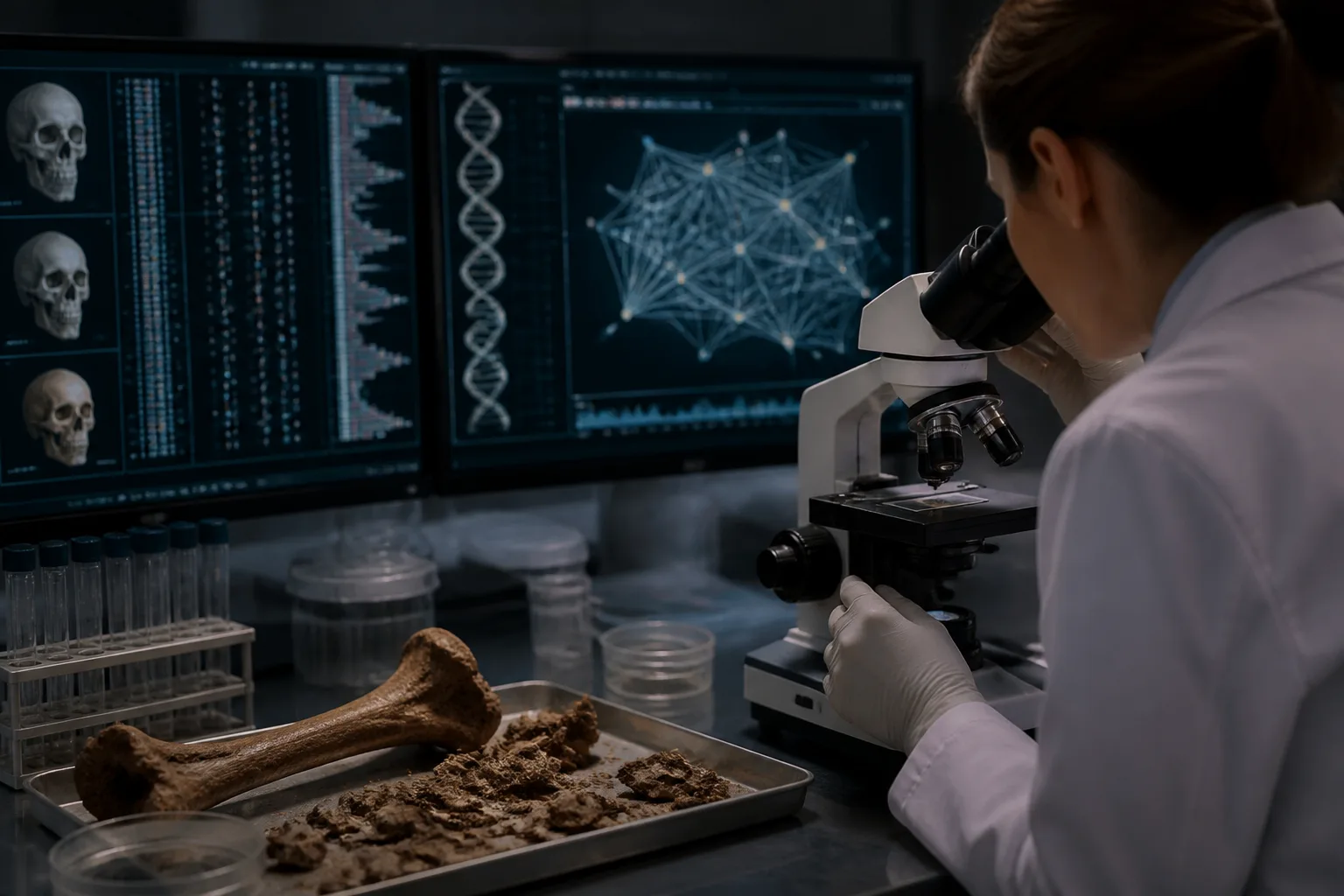
That is a familiar pattern in modern data science. When the signal is subtle, better instrumentation alone is not enough. Researchers also need statistical tools that can separate cause from correlation and reduce confounding factors. Reich and his colleagues appear to have done exactly that, allowing them to detect small but persistent changes that accumulated over long time spans.
The paper’s broader claim also matters for how scientists think about human systems in general. The source says evolution is still responding to cultural, economic, and environmental changes. In other words, technological and societal shifts do not sit outside biology; they can reshape the pressures acting on populations over time.
The study is also a reminder that modern labels can be misleading when applied backward. Reich cautions that a gene’s function thousands of years ago may not match its role today, and that individual variants may require much more study before strong conclusions can be drawn. That warning is important for anyone reading biological data as if it were a simple dashboard of traits. Complex systems often look clearer than they are.
For software and data-analysis teams, the more general lesson is about inference under uncertainty. The research does not just depend on having more data. It depends on designing a workflow that can compare individuals across time, absorb heterogeneity, and minimize misleading signals. That kind of methodological discipline is increasingly central in fields that handle large, messy datasets.
What to watch
The source says Reich and Ali Akbari want to expand the work to additional populations, including geographically isolated groups, to get a broader view of evolution worldwide. That would test whether the patterns seen in Europe also show up elsewhere.
They also want to study the variants more closely to infer what they did in the past. That is a likely next step because the current findings identify signals of selection, but not always the full functional story behind them.
More broadly, this line of research may continue to evolve as ancient-DNA datasets grow and analytical methods improve. The study suggests that the combination of larger sample sets and better statistical techniques can reveal patterns that were previously invisible. If that holds, the next advances may come less from new claims about single genes and more from better ways to interpret the data at scale.
For now, the central takeaway is straightforward: the human species did not stop evolving once civilization began. The tools used to detect that fact are what made the story visible.