Key Takeaways
- A drawing arena put four vision models on the same blank canvas with the same colored-pencil toolset.
- GPT-5.6 Sol was the source’s top pick on quality, while Claude Fable 5 was the slowest and most expensive.
- Gemini 3.6 Flash reached the highest SSIM score on the target drawings, but more self-review did not always improve the final result.
What happened
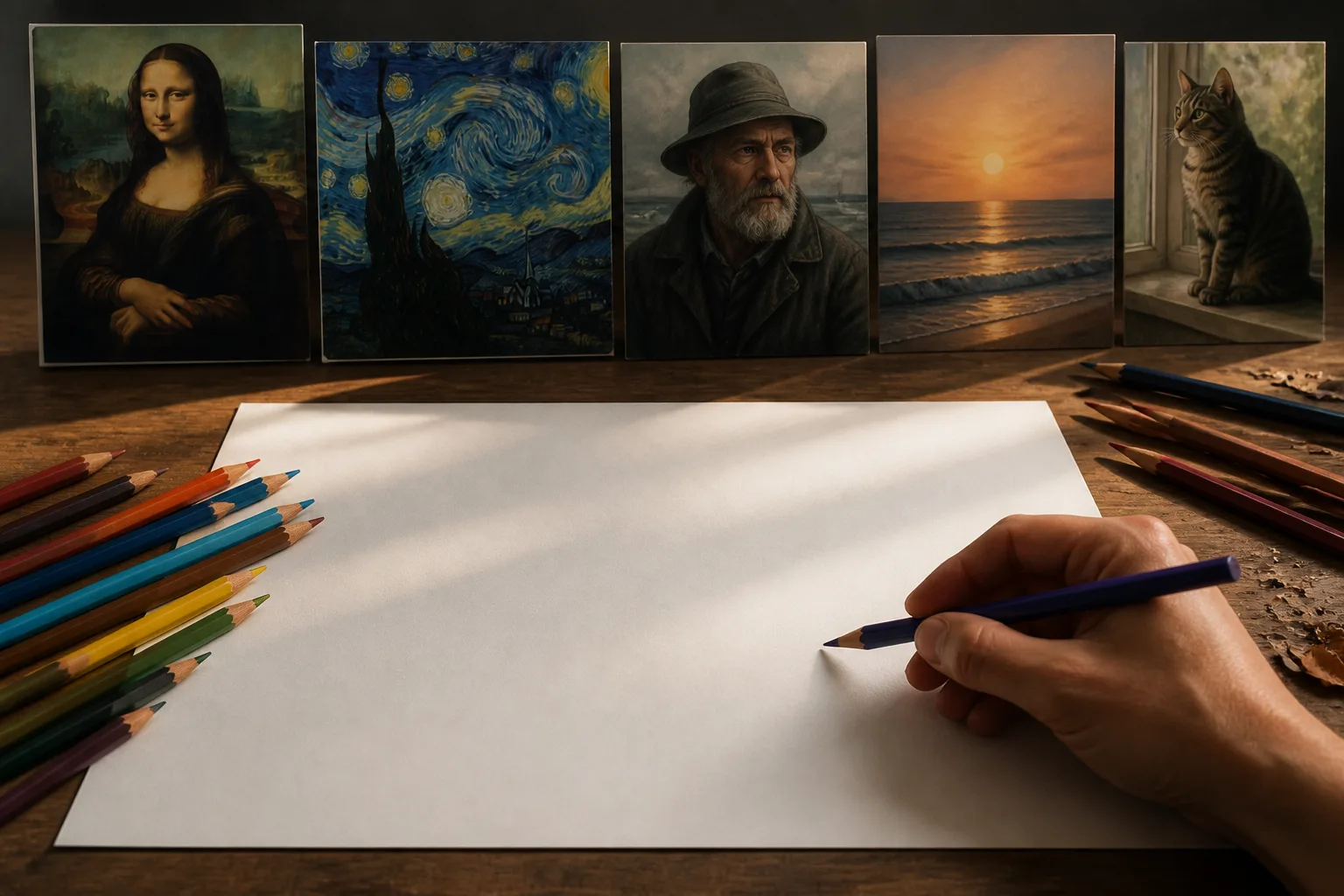
The source describes an open-source “drawing arena” that gives a model a blank white canvas and a limited set of drawing tools, then asks it to either recreate a target image or respond to a text prompt. The toolset includes planning, viewing the target, viewing the canvas, choosing color, brush width, and pressure, drawing strokes, smudging, erasing, and clearing the canvas.
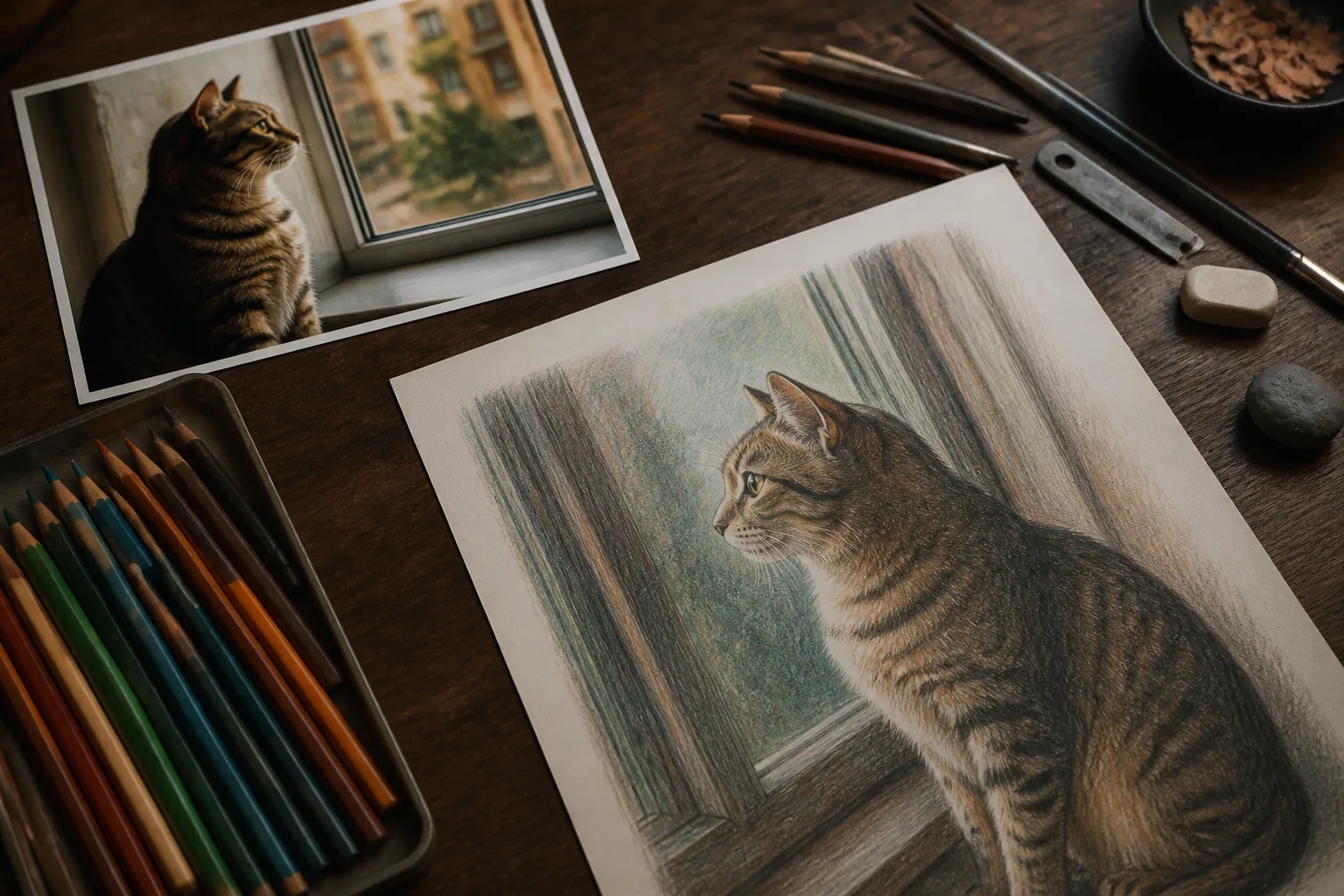
The author ran four vision models — GPT-5.6 Sol, Claude Fable 5, Grok 4.5, and Gemini 3.6 Flash — across seven drawings each. Two of those tasks were target reproductions, the Mona Lisa and Van Gogh’s Starry Night, scored with structural similarity metrics. The other five were open-ended prompts, such as a weathered fisherman, a sunset over a calm ocean, and a tabby cat on a windowsill.
Across the runs, the models used the same tools in different ways. GPT-5.6 Sol reportedly did not call the separate color, brush, or pressure-setting tools at all, instead setting those values inside draw calls. Grok 4.5 relied heavily on the setup tools and averaged 99 steps per drawing. Claude Fable 5 leaned on smudging and frequent review. Gemini 3.6 Flash was the most frequent canvas checker, with about 23 self-reviews per drawing.
The source also reports wide differences in cost and token usage. Claude Fable 5 was estimated at about $160 for the seven drawings, roughly 20 times the cost of GPT-5.6 Sol, Grok 4.5, or Gemini 3.6 Flash. Grok used the most tokens overall, but most were cached reads. Gemini also relied heavily on cached reads.
Why it matters
This is not presented as a formal benchmark of general model quality. Instead, the source frames it as an intentionally open-ended test that can reveal how models behave on long-running, visual, tool-based tasks.
That makes the experiment useful for a few software and AI-adjacent reasons. First, it shows how differently models can approach the same task when they are given an identical tool interface. Second, it highlights that more checking does not necessarily produce better final output: the source says every model plateaued early, and in all eight target runs the final frame scored below the best frame reached mid-run. Third, it puts a real cost on iteration. One model may look stronger qualitatively, but another may reach a comparable or better result with much less overhead.
The source’s own take is blunt: GPT-5.6 Sol was the strongest overall performer in this setup, Grok 4.5 was not dependable for this visual task, and Claude Fable 5 delivered second-place quality at the highest cost and time burden.
For readers tracking product behavior rather than abstract benchmarks, the more interesting point may be how tool use, review loops, and token economics shape the output. A model that repeatedly checks its own canvas is not automatically a better artist, and an expensive model is not automatically the best fit for iterative visual work.
What to watch
The source says the harness is open source, so one thing to watch is whether others reproduce the setup with different targets or tool constraints.
Another open question is whether future models improve at using the feedback loop more efficiently. The source suggests that current models often keep editing after reaching their best frame, which could matter for any future agentic visual workflow.
It is also worth watching how newer model generations compare on this kind of task. The source mentions that the authors are interested in seeing how Gemini 4 performs, and notes that open-weight models may become more viable as implementations mature.
For now, the main lesson is narrow but useful: on a blank-canvas drawing task, models can behave very differently even when they share the same tools, and the best-looking result may not come from the model that checks itself the most.