Key Takeaways
- A bowling-center owner says a 2008-installed scoring system would cost about $80,000 to $120,000 to replace.
- He says he has built a prototype using ESP32 boards, ESPNow, RS485 fallback, relays, optocouplers, IR break-beam sensors, a Raspberry Pi, and Redis.
- The project is intended to reduce vendor lock-in and may be open sourced as OpenLaneLink.
What happened
A Hacker News post from a bowling-center owner describes an attempt to replace the scoring and lane-control system in an eight-lane alley with commodity hardware.
The owner says his family bought an abandoned bowling center in the rural Midwest. He describes the building as rough condition: the roof leaks, the electrical system surges, and the 70-year-old bowling equipment still does not work perfectly. In that setting, the scoring system became the most interesting and expensive part of the setup.
According to the post, the current system was installed in 2008 and cost six figures at the time. He says that a like-for-like replacement would now run between $80,000 and $120,000 depending on features, vendor, and unit age. He also says replacement parts cost about $4,000 per pair of lanes.
The post argues that, despite the price, the underlying job of the system is relatively narrow. The lane electronics, as described there, are mainly responsible for actuating a relay to trigger the older mechanical machine. The rest of the bowling machinery is said to be strictly mechanical.
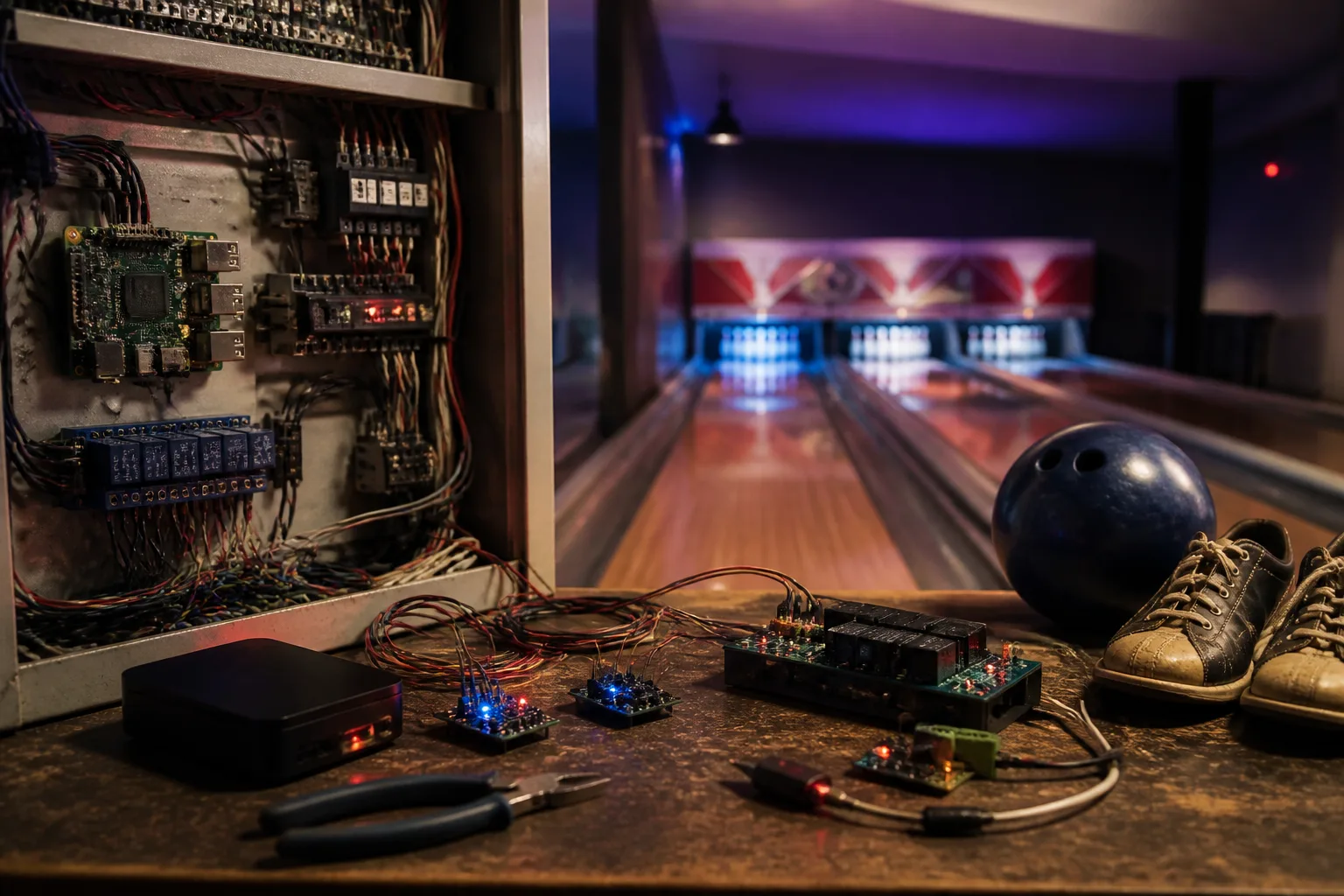
From that starting point, he says he began building an alternate system using ESP32 microcontrollers. His prototype reportedly uses ESPNow, with an RS485 fallback for noisy radio environments. A Raspberry Pi serves as the lane computer, while Redis and a state machine handle the higher-level coordination.
He describes the hardware as common off-the-shelf parts: microcontrollers connected to relays, optocouplers, and IR break-beam sensors, each with slightly different firmware. In his design, nodes emit events from their sensors and accept commands for controls, then send those messages to a gateway node connected to the Raspberry Pi over UART. The gateway translates packets into Redis, and commands flow back out through the mesh when needed.
The post frames the remaining software as familiar web infrastructure: middleware, React, WebSockets, and pub-sub. The author says the point is not just to reduce cost, but also to own the data and avoid depending on proprietary vendor systems for every change or support call.
Why it matters
The central technology story here is not bowling itself, but the contrast between a niche industrial system and the open-hardware stack used to replace it.
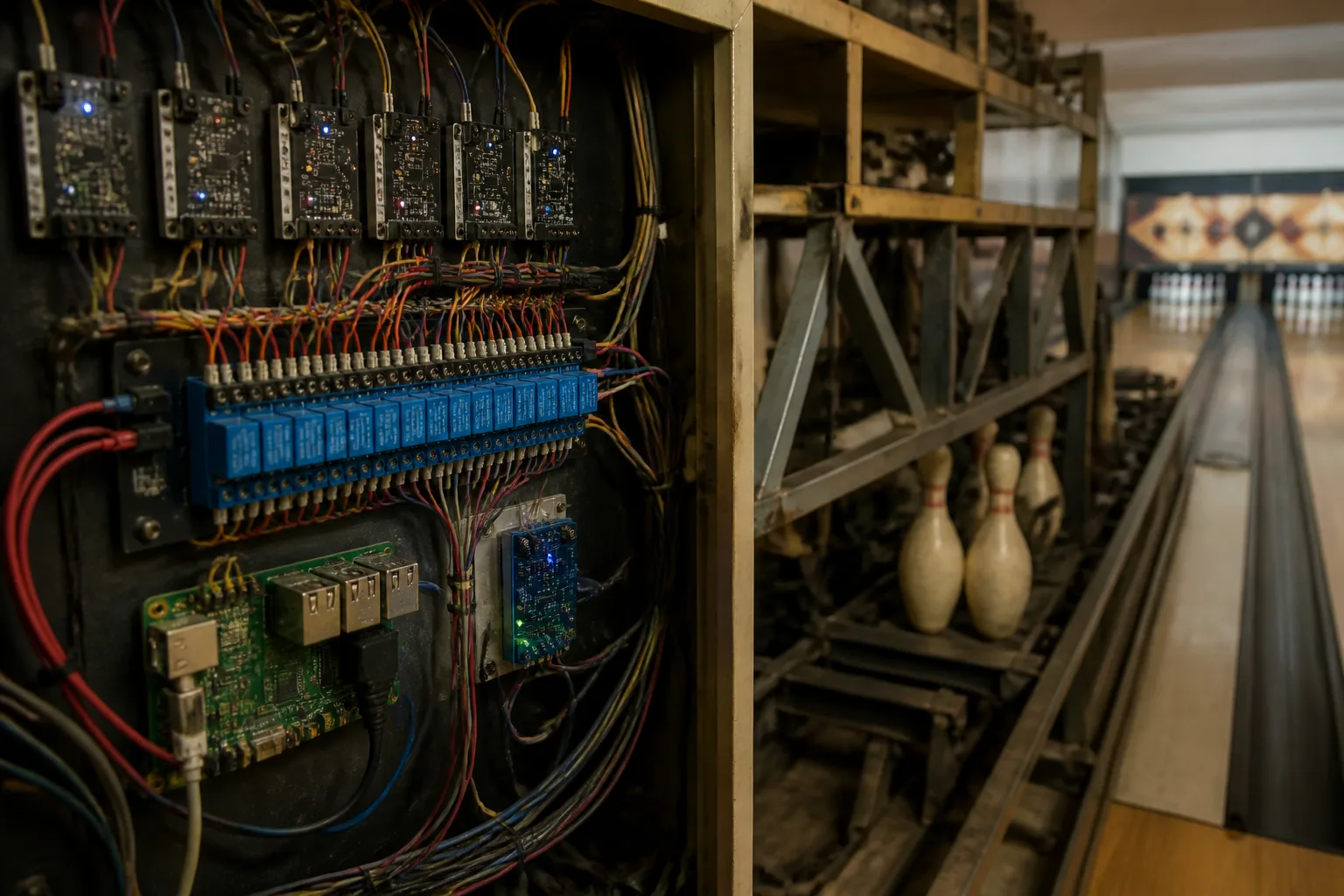
The post suggests that older specialized systems can remain expensive even when their core function is relatively simple. In this case, the author is surprised that a scoring system from 2008 still commands a large replacement price, even though much of the surrounding bowling machinery is mechanical and much older.
The alternative described in the post is notable because it uses parts and concepts common in modern maker and systems projects: ESP32 microcontrollers, event-driven messaging, a Raspberry Pi coordinator, and Redis as a backbone for state and commands. The author also emphasizes redundancy, with RS485 available when radio is unreliable.
There is also a maintenance angle. The post says repairs can be fast, with the rig on a lane pair swappable in under 10 minutes, and that a site could potentially go from zero to running in an hour or two. Those claims are part of the author’s case for building on commodity hardware rather than relying on a closed vendor stack.
The project is called OpenLaneLink, and the author says he plans to open source the hardware, firmware, and software stack when it is ready. He presents that as a way to keep bowling more affordable for smaller alleys and to avoid paying for proprietary customization of equipment the operator already owns.
What to watch
The post is a prototype description, not a completed product announcement. What to watch next is whether OpenLaneLink becomes a full, reusable system and whether the hardware and firmware are actually released.
It will also matter whether the system proves reliable in the messy conditions the author describes: power surges, old machinery, and the possibility of noisy RF environments. The presence of an RS485 fallback suggests the author is already thinking about robustness, but the post does not provide long-term test results.
Another open question is how much of the lane experience can be replicated cleanly with commodity parts. The author says the existing system handles ball-speed and trajectory calculations, camera-based pin detection, foul detection, animations, and machine control. He argues that much of that can be re-created with modern open hardware and software, but the post does not yet show a finished replacement.
For now, the main takeaway is that a niche, expensive legacy system may be vulnerable to being rethought as an integration problem rather than a specialized black box. In this case, that rethinking is happening in a bowling alley, with ESP32s, Redis, and a lot of owner-maintained code.