Key Takeaways
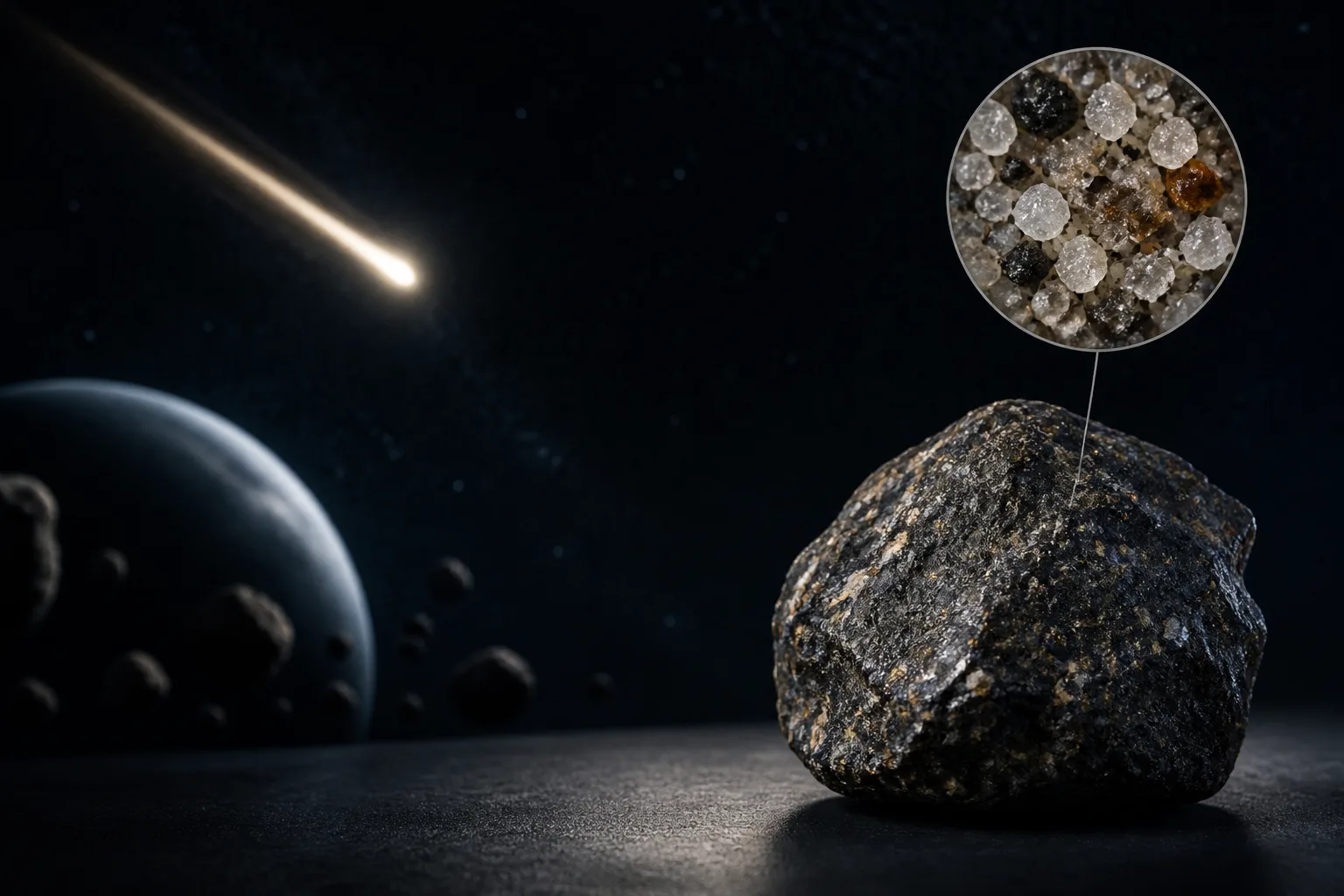
- A meteorite that fell through a New Jersey home was identified as a rare CM1/2 carbonaceous chondrite.
- Scientists found salt-rich fragments and organic compounds that point to past briny chemistry on the meteorite’s parent asteroid.
- The sample adds to broader asteroid-sample research relevant to prebiotic chemistry and the study of life’s building blocks.
What happened
An international team of researchers reported in Science Advances on a meteorite that crashed into a house in Hillsborough, New Jersey, after a daytime meteor crossed the region on July 16, 2024. The event was observed across several states, and cameras plus eyewitness reports helped researchers reconstruct the object’s path back to the asteroid belt.
The recovered rock was analyzed as part of a forensic-style study of the fragments. According to the source, the meteorite belongs to a rare primitive class known as a CM-type carbonaceous chondrite, with the Hillsborough specimen classified as a CM1/2 meteorite. That means it shows more water-related alteration than is typical for many CM2 meteorites, but it is not as altered as CM1 material.
The homeowner preserved the fragments quickly after impact, which researchers say helped keep the sample unusually pristine. The source notes that this is only the second witnessed fall of a CM1/2 carbonaceous chondrite.
Why it matters
The scientific interest here is not the impact event itself, but what the rock preserved about its origin. Researchers report small salt-rich fragments inside the meteorite, suggesting they came from near the surface of the parent asteroid, where water may once have evaporated and concentrated salts.
That matters because briny fluids can shape chemistry in ways that may be relevant to the earliest stages of life. The source says brines can keep phosphate in solution, help catalyze reactions among organic compounds, and influence mineral formation. The meteorite also contained carbon, nitrogen, soluble organic compounds, and amino acids, all of which add to the evidence that carbonaceous chondrites can carry prebiotic materials.
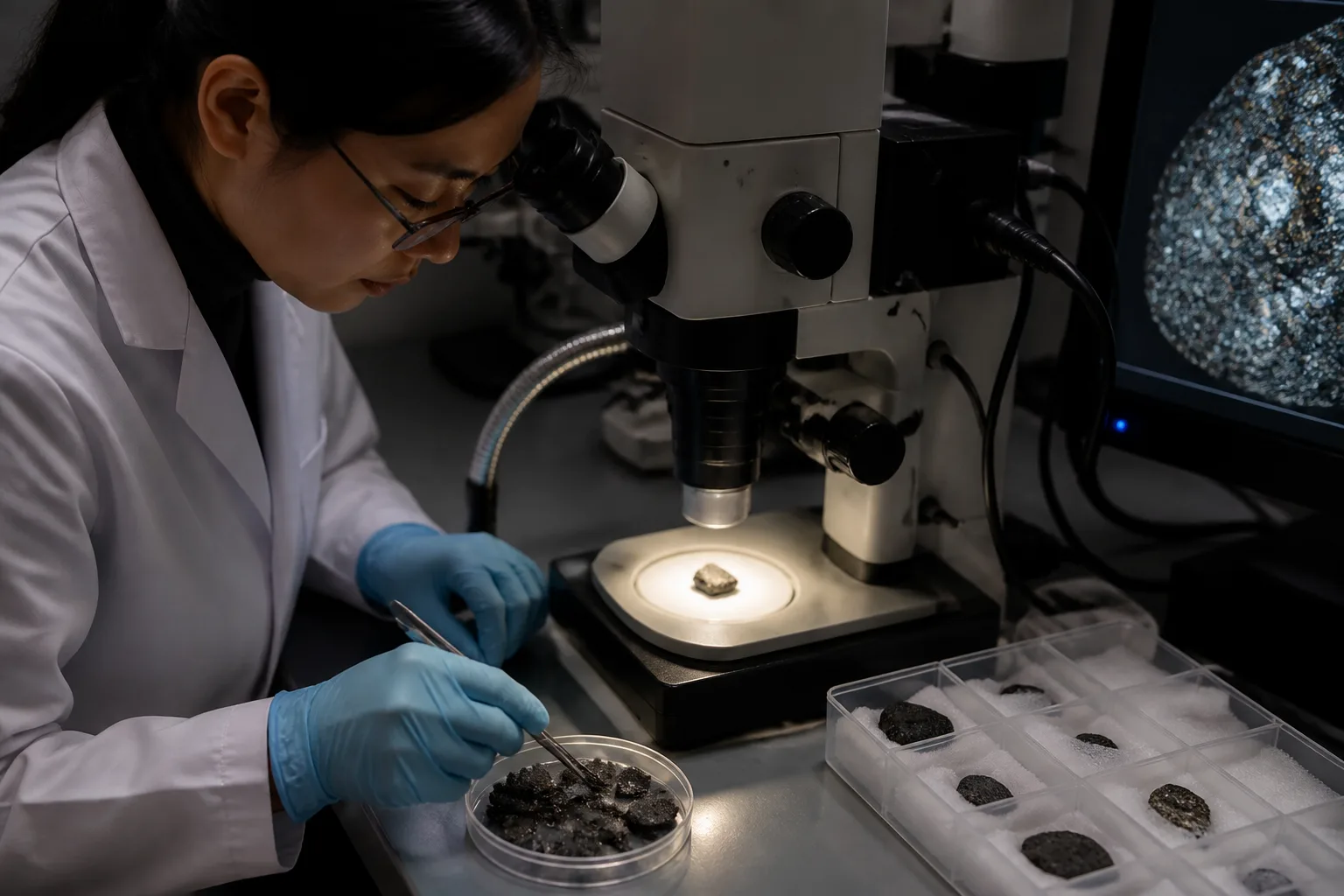
Several comparisons in the source place the discovery in a wider sample-analysis context. Scientists are comparing the salt phases in the Hillsborough meteorite with minerals seen in samples returned from asteroids Ryugu and Bennu. That makes the finding part of a larger effort to understand how asteroid chemistry evolves and what kinds of molecules primitive bodies can preserve.
What to watch
Researchers are still working to identify the specific salt minerals in the meteorite and compare them with returned asteroid samples. That step should help clarify whether the chemistry reflects brine-driven alteration on the parent asteroid or another process.
The source also says some fragments will be curated at the American Museum of Natural History, which should make the specimen available for further study. Future work may refine how Hillsborough fits among CM-type meteorites and what its unusual preservation says about water, organics, and mineral reactions on small bodies in the early solar system.
Source context in the research record
The report ties the meteorite to a peer-reviewed paper in Science Advances and places it alongside prior sample-return missions and meteorite studies. The technology angle is therefore indirect: this is primarily a planetary science and astrobiology story, with relevance to analytical methods, sample curation, and comparison with mission-returned asteroid material.