Key Takeaways
- The paper proposes a new audio representation, a modulation tensorgram, that keeps the time dimension for hive monitoring.
- The method is tested with CNN and convolutional recurrent neural network models on the public UrBAN dataset.
- The authors report better accuracy, cross-hive generalizability, and robustness to noisy recording conditions than prior benchmark methods.
What happened
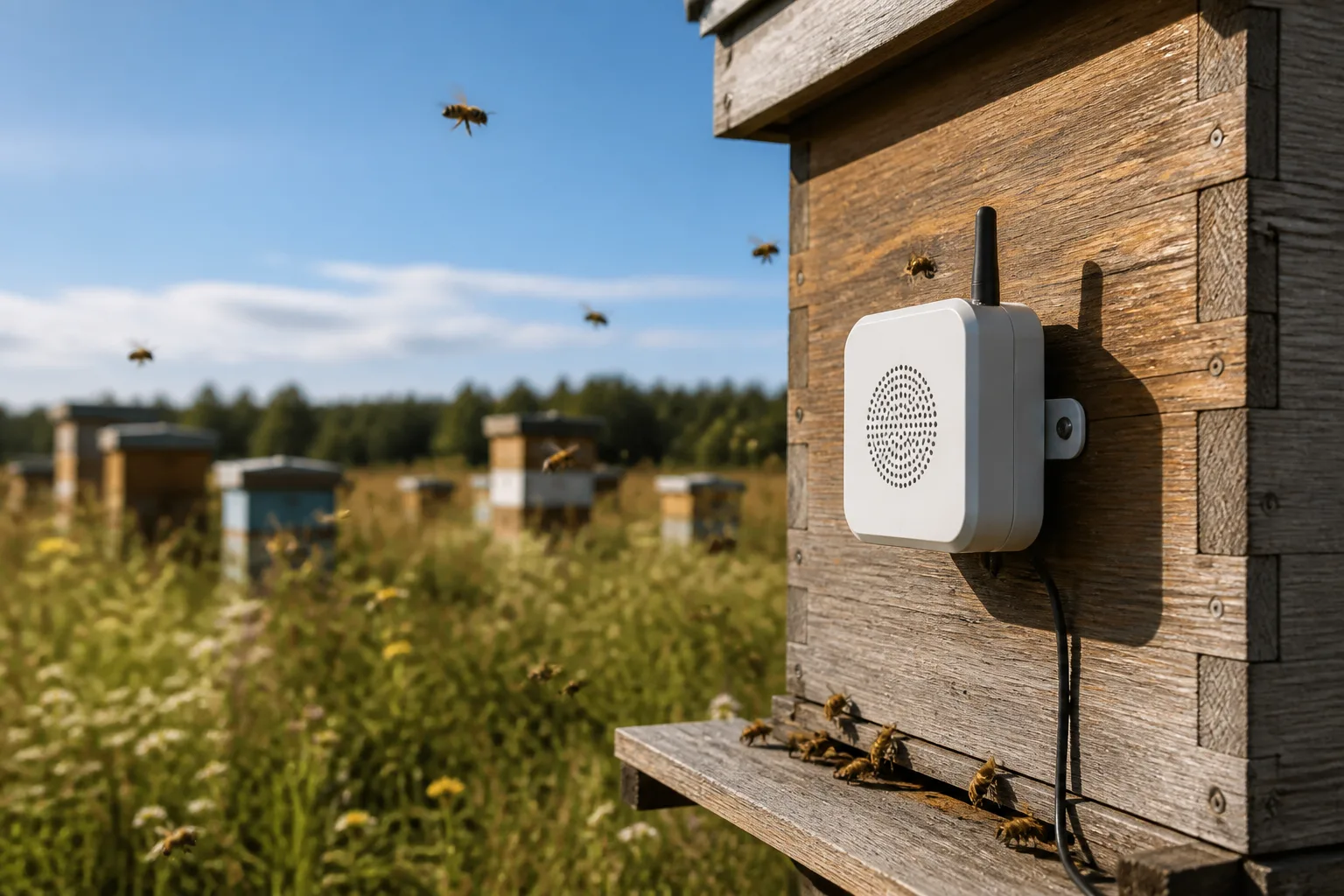
A paper posted to arXiv describes a new approach to monitoring honey bee colony strength using audio Internet of Things sensors and deep learning. The work argues that remote hive monitoring matters because honey bees are important pollinators in agriculture and ecosystems, and because colony strength can be difficult to assess continuously without physical inspection.
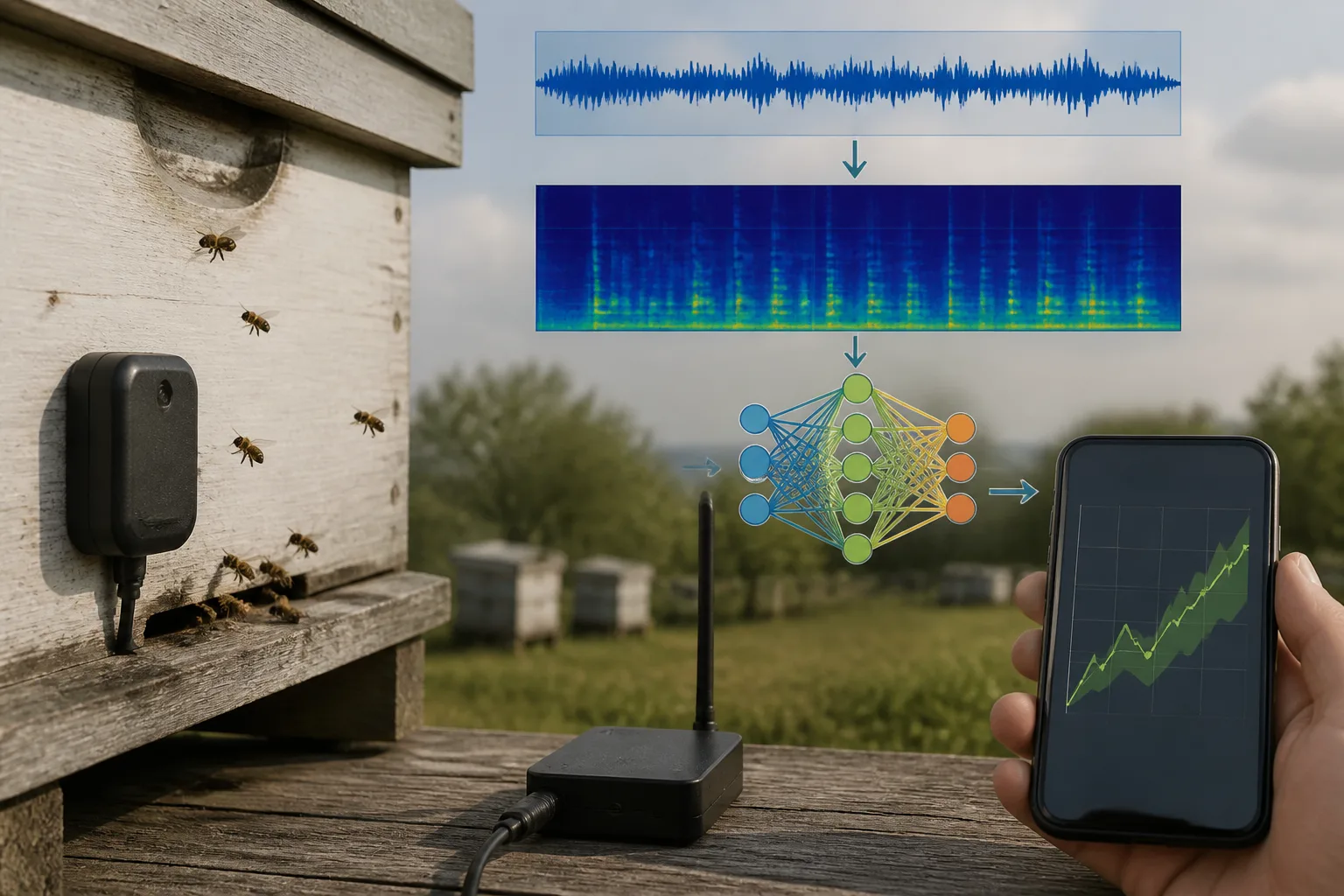
The authors focus on information in the modulation spectrum of hive audio. They say earlier methods used handcrafted features from that spectrum, but those approaches may lose useful temporal information. Their proposal is a modulation tensorgram, a representation that keeps the time axis instead of collapsing it away.
That representation is then fed into two model families: a convolutional neural network and a convolutional recurrent deep neural network. In the abstract, the paper says these models are evaluated on the public UrBAN dataset, which contains more than 3,000 hours of beehive audio recordings.
According to the source, the results show improvements over prior benchmark methods in both accuracy and cross-hive generalizability. The authors also say the method appears more robust to noisy, real-world recording conditions.
The paper also includes explainability analysis using saliency maps and gradient-weighted class activation maps. Those tools are used to examine what parts of the input drive model decisions. In the abstract, the authors say this analysis supports the importance of temporal dynamics in the modulation spectrum for the task.
Why it matters
The technical interest here is not just that the system listens to hives, but that it tries to preserve more of the structure in the audio signal before classification. In the abstract, the authors frame the central question as whether temporal dynamics in the modulation spectrum carry discriminative information that previous representations missed. If that is true, the modeling choice could matter as much as the sensor choice.
That makes the paper relevant to a broader class of edge and environmental monitoring problems. Many IoT systems rely on cheap, distributed sensors and then try to infer a higher-level condition from noisy data. In that setting, the choice of feature representation can be decisive. A model may perform better not because it is dramatically larger, but because it is given an input that preserves the right kind of structure.
The source also emphasizes generalizability across hives. That is an important detail for practical deployment, because a model that works only on one hive or one recording setup would have limited operational value. The abstract says the proposed method improves cross-hive generalizability, suggesting the authors are trying to address a common weakness in machine-learning systems that perform well in controlled settings but degrade when moved to new environments.
Robustness to noisy, in-the-wild conditions is another notable point. Audio sensing in outdoor or semi-controlled settings is often exposed to wind, ambient noise, and placement differences. If the method really holds up better under those conditions, that would make it more realistic for monitoring programs that need long-running deployment rather than short lab demonstrations.
The explainability results are also relevant. For an environmental or agricultural monitoring tool, it is useful to know whether the model is making decisions based on meaningful signal regions rather than incidental artifacts. The paper’s saliency and class-activation analysis appears intended to show that the model is attending to modulation-spectral temporal dynamics, which aligns with the authors’ hypothesis.
What to watch
The source is an abstract, so the strongest claims available are limited to what the authors report at a high level. The paper says performance improved on the UrBAN dataset, but the abstract does not provide the exact metrics, benchmark names, or experimental setup details needed to judge the size of the gain.
It would also be important to see how the method behaves outside the dataset described in the paper. The abstract mentions cross-hive generalizability, but it does not indicate how many hives were tested, whether the recordings came from different environments, or how sensitive the approach is to sensor placement and recording quality.
Another question is deployment cost. The abstract makes clear that the system uses audio IoT sensors and deep learning, but it does not specify the compute requirements for inference or whether the approach is intended for edge devices, cloud processing, or a hybrid setup. That matters for any real monitoring product.
Finally, the paper’s explainability claims would benefit from more detail in the full text. Saliency maps and class-activation maps can be useful, but their interpretation depends on how they are applied and validated. The abstract suggests they support the main hypothesis, but the degree of evidence is not fully clear from the source provided.
Overall, the paper points to a technically interesting direction: preserving temporal information in audio representations may improve how machines monitor honey bee colonies. Based on the abstract alone, the work looks like a research advance in acoustic sensing and machine learning rather than a finished product claim.