Key Takeaways
- Nvidia is using Vera Rubin to market itself as a supplier of complete AI systems, not just GPUs.
- The company says the new stack improves power efficiency, memory bandwidth, and rack installation speed.
- CPUs, networking, and system integration are becoming more important as AI workloads grow more agentic and complex.
What happened
Nvidia has started revealing more details about Vera Rubin, its next major chip system, and it is using the launch to make a broader pitch: the company wants to provide much more than the GPUs that made it dominant in AI computing.
At a technical workshop at Nvidia’s headquarters in Santa Clara, California, executives described Vera Rubin as the company’s next step in AI infrastructure. The system is built around a CPU-GPU pairing, and Nvidia says it is increasingly positioning itself as a supplier of CPUs as well as GPUs.
That shift matters because AI systems are changing. While GPUs still do most of the heavy lifting for training and running models, more complex, agentic AI systems require CPUs to manage data flow, networking, and other software tasks. Nvidia is leaning into that trend by promoting complete systems rather than isolated chips.
Vera Rubin is the successor to Nvidia’s Grace Blackwell hybrid superchip. Nvidia says the Vera Rubin NVL72 system is designed around one CPU for every two GPUs, with 36 Vera CPUs paired with 72 Rubin GPUs inside a single superchip system. The company is also selling the Vera CPU separately.
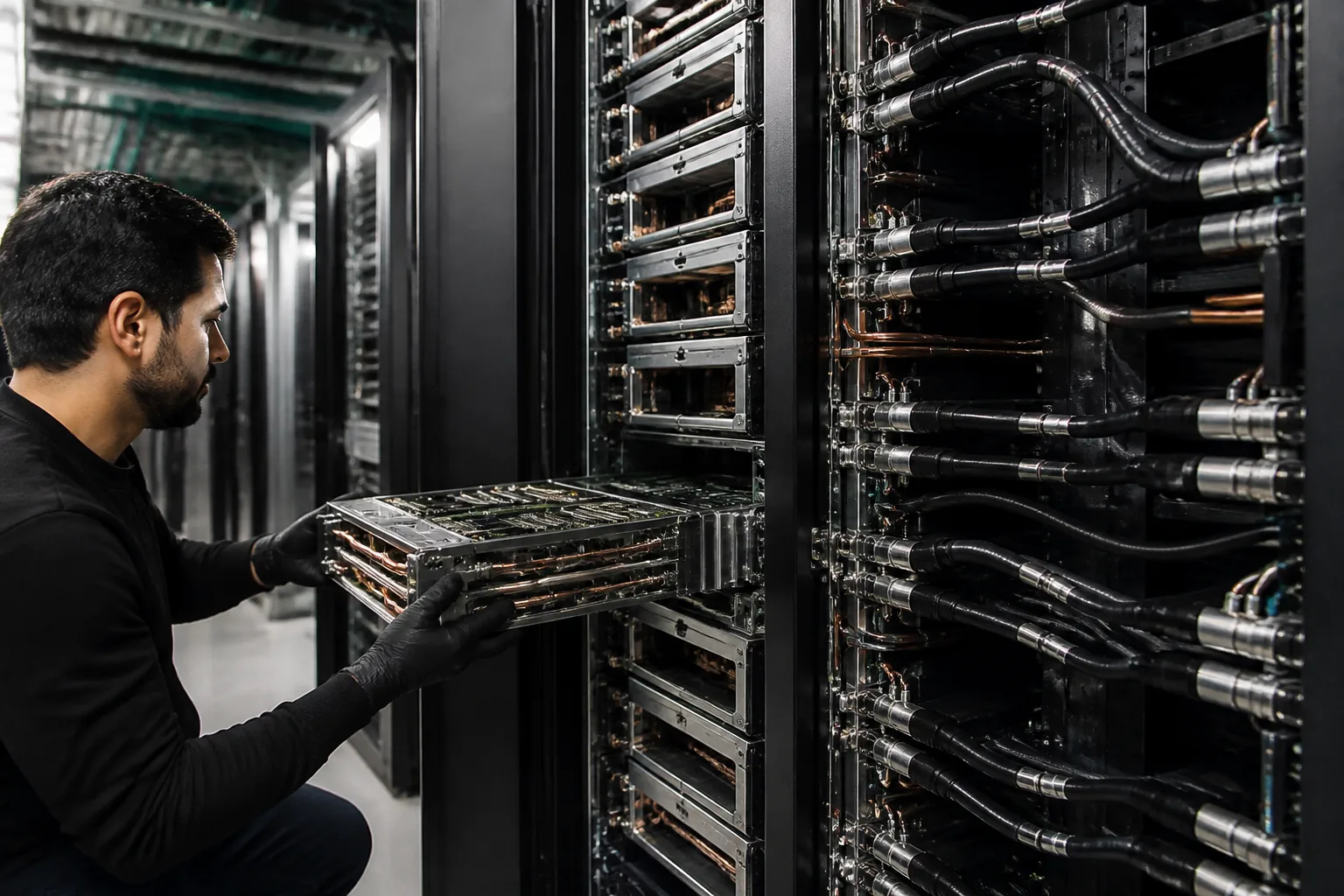
Nvidia executives said the NVL72 racks are more plug-and-play than earlier products. They also said the racks are liquid-cooled, intended to reduce energy use, and that the design cuts down on cabling enough for Nvidia to describe it as “cable-free compute” and “hot-swappable.”
According to the company, the rack design could reduce installation time from hours to minutes. Nvidia also said that OpenAI already has one Vera Rubin rack in use.
Why it matters
Nvidia’s pitch is not just about faster chips. It is about control over more layers of the AI data center.
As AI demand shifts toward larger, more tightly integrated systems, the companies buying infrastructure may care less about a single accelerator and more about the full stack: CPUs, GPUs, memory, networking, cooling, and the software that binds them together. Nvidia is trying to make itself the default supplier for that whole package.
The company says Vera Rubin will deliver 10 times as many tokens per watt as Grace Blackwell, and that its new CPU is faster at agentic AI tasks than comparable CPUs from AMD and Intel. Nvidia also says the system has nearly three times the memory bandwidth of Blackwell, which could be especially important amid shortages of high-bandwidth memory.
There is also a hardware-design argument behind the pitch. Nvidia executives said Vera abandons the chiplet model used by many modern processors in favor of a single monolithic chip. Their claim is that chiplets create a penalty for memory bandwidth and data movement, while a monolithic design lets data move faster across one integrated circuit.
That is a technical choice with business implications. If customers accept Nvidia’s framing, then future AI purchases could shift from buying discrete chips to buying Nvidia-defined systems that are harder for rivals to match piece by piece.
What to watch
One major question is whether Nvidia’s claims hold up in the market as customers deploy Vera Rubin at scale. Much of the current message is coming from Nvidia itself, so outside validation will matter.
Another point to watch is timing. Nvidia says Vera Rubin is ramping to full production and will ship in the second half of this year, with early customers including Microsoft, OpenAI, and Oracle. The company is sensitive to any sign of delay after reports that its previous Blackwell chips overheated in customized server racks, forcing design changes and shipment shifts.
Competition is also heating up. Nvidia’s Vera Rubin push comes just ahead of AMD’s annual conference, where AMD is expected to talk about its next-generation AI and data center chips. AMD has been gaining share in data center CPUs and is also targeting large AI infrastructure contracts.
The broader industry question is whether the next phase of AI infrastructure spending will center on individual chips or on tightly integrated systems. Nvidia clearly believes the answer is systems, and Vera Rubin is its latest attempt to make that case.