Key Takeaways
- OpenAI’s first branded hardware is reportedly the $230 Codex Micro, a compact RGB-lit keyboard made for monitoring and interacting with Codex agents.
- The device uses color-coded keys to show agent status at a glance and includes shortcut controls for common Codex tasks.
- As a limited-run collaboration with Work Louder, it points to OpenAI testing a very specific desktop workflow rather than launching a general-purpose gadget.
What happened
OpenAI’s hardware efforts are starting to take a more visible form, but not in the way many might have expected. According to Ars Technica, the company is rolling out its first branded device: a $230 mini-keyboard called the Codex Micro.
The product is described as a limited-run collaboration with Work Louder, a maker that already sells a similar square keyboard line aimed at creative professionals. OpenAI’s version keeps that general format, but adapts it for Codex, the company’s coding-focused agent system.
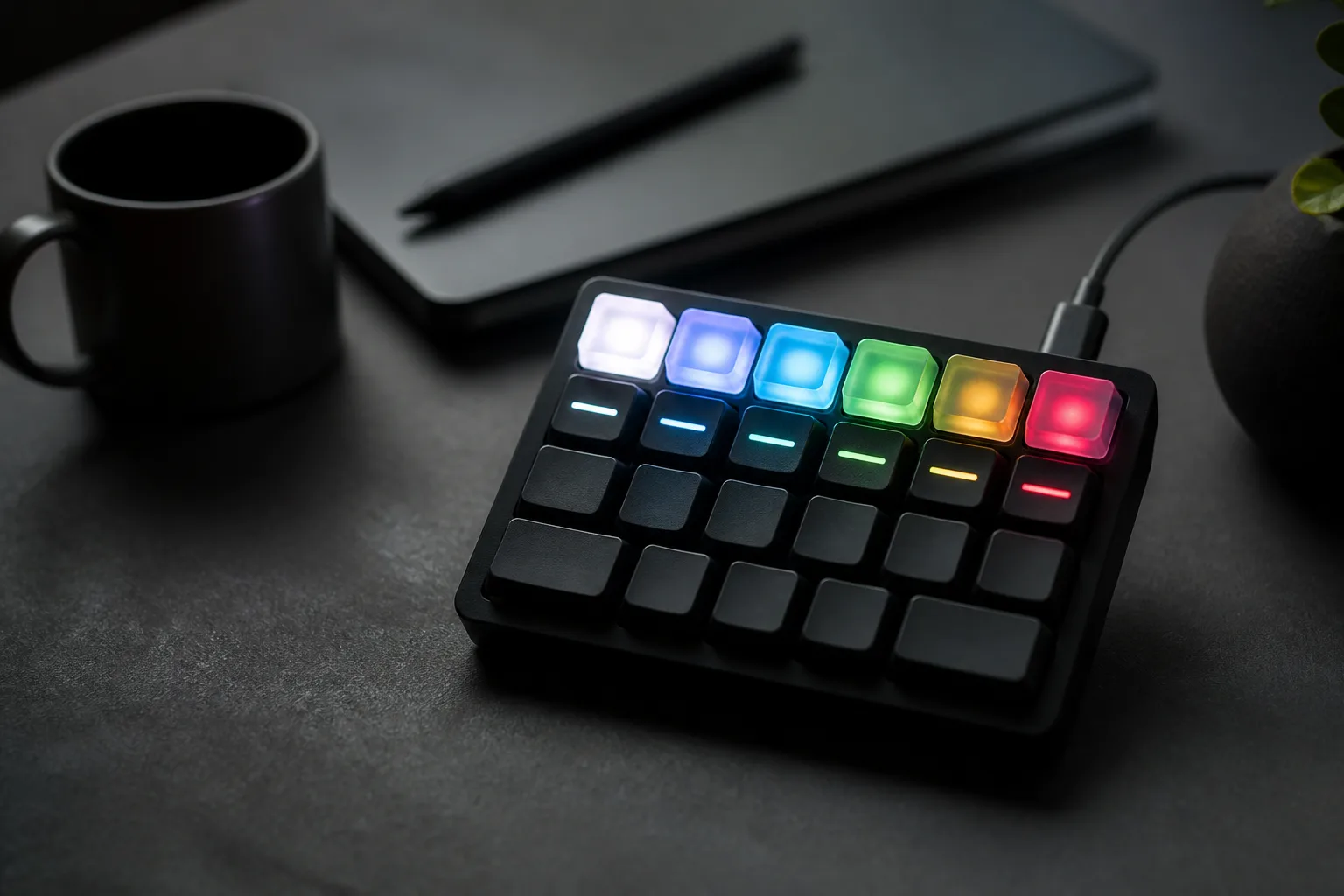
The most distinctive part of the device is a set of six frosted keys near the top. Those keys are designed to provide live, color-coded feedback for up to six Codex threads, even when those threads are not currently visible on the screen. In the reporting, the keys are said to shift from white when idle to blue while Codex is thinking, green when a task is complete, amber when human input is needed, and red when an error occurs.
That setup turns the keyboard into a kind of physical dashboard. A user can see which threads are active, which ones need attention, and which ones have finished without switching windows or digging through menus. A tap on the relevant lit key is meant to open the corresponding Codex window on screen.
Below those status keys, the Codex Micro includes six more buttons mapped by default to tasks such as accepting or rejecting changes, branching threads, and using a push-to-talk function for audio prompts. The software layer is not fixed, however. The buttons can be remapped, and the device ships with 32 interchangeable keycaps. OpenAI also says users can program the keyboard for five additional function sets beyond the default Codex layer.
Why it matters
This is notable less because it is a flashy consumer product and more because it reveals how OpenAI may be thinking about AI workflows in practice.
The Codex Micro appears to be designed for people who keep multiple AI tasks running at once and want a fast, low-friction way to watch them. In that sense, it suggests a future where AI use is not only something that happens in chat windows, but something that benefits from always-on monitoring and physical controls.

That is an important clue about product strategy. OpenAI has been widely discussed in relation to possible hardware experiments, including rumors of a personalized smart speaker and other devices. But this first branded release points in a different direction: a specialized desktop accessory built around a specific product rather than a broad-purpose assistant.
The device also underscores how much of today’s AI tooling is still tied to the computer desk. The article notes that the keyboard attachment is mainly useful in a desktop setting, even if ChatGPT’s mobile app may offer more detailed monitoring away from the desk. That contrast matters because it shows the gap between mobile AI convenience and the more complex oversight needed for agentic workflows.
In other words, the Codex Micro is not just a keyboard with lights. It is an attempt to make agent status legible in physical space. For users managing several AI threads, that could make the experience feel more immediate and less hidden inside software.
What to watch
The first question is whether OpenAI treats this as a one-off collaboration or a sign of a broader hardware roadmap. The reporting frames the device as limited-run, which suggests experimentation rather than a full consumer launch.
Another thing to watch is whether the idea of physical AI controls resonates beyond a narrow developer audience. The Codex Micro’s value seems tied to specific workflows: tracking tasks, approving changes, branching threads, and handling prompts. That makes it useful for some users, but not necessarily for everyone.
It will also be worth watching how OpenAI positions future hardware relative to this release. If the company continues exploring devices, this keyboard could be an early example of a strategy centered on task-specific accessories rather than standalone gadgets.
For now, the Codex Micro offers a clearer picture of OpenAI’s near-term hardware thinking than any rumor about a speaker or general-purpose companion device. It is specialized, desk-bound, and deeply tied to Codex. That makes it unusual, but also revealing: OpenAI may be testing how AI products work when they are given a physical interface designed around constant status awareness and quick intervention.